


Most IT teams aren’t struggling with a lack of security controls. They’re struggling with the growing complexity of managing them.
A single environment may need to satisfy ISO/IEC 27001, NIST CSF, PCI DSS, DORA, NIS2, and industry-specific regulations at the same time. Although these frameworks share many of the same objectives, they’re often implemented as separate initiatives. The result is duplicated controls, fragmented documentation, inconsistent governance, and far more time spent preparing for audits than improving security.
IT governance, risk, and compliance addresses this challenge by bringing governance, risk management, and compliance into a single operating model. Rather than treating each framework as its own project, this approach helps organizations establish a unified governance structure, a common control strategy, and a consistent process for demonstrating compliance across multiple requirements.
It’s also important to distinguish IT governance, risk, and compliance from enterprise GRC. Enterprise GRC provides oversight across the entire organization, including finance, legal, HR, and operations. IT governance, risk, and compliance applies those same principles specifically to technology, ensuring that IT investments support business objectives, technology risks are managed consistently, and security controls meet both regulatory and operational expectations.
This guide explains what IT governance, risk, and compliance is, how it differs from IT governance, the role of frameworks such as COBIT 2019, ITIL, ISO/IEC 27001, and NIST CSF 2.0, and how IT teams can build a governance program that supports both business growth and regulatory compliance.

Key Takeaways
- IT governance, risk, and compliance provide a structured approach for aligning technology decisions with business objectives while managing IT risks and meeting regulatory requirements.
- IT governance focuses on strategic oversight, while risk management and compliance help organizations identify technology risks, implement effective controls, and demonstrate regulatory compliance.
- COBIT 2019, ITIL, ISO/IEC 27001, and NIST CSF 2.0 are complementary frameworks, each addressing a different aspect of IT governance, service management, information security, or cyber risk management.
- A unified control framework enables organizations to meet multiple regulatory requirements without creating duplicate controls, documentation, or compliance programs.
- Building an effective governance program requires continuous assessment, clearly defined ownership, ongoing monitoring, and regular improvement as business priorities, technologies, and regulations evolve.
- As organizations expand their use of cloud platforms, AI, and other emerging technologies, IT governance, risk, and compliance have become essential for building secure, resilient, and well-governed IT operations.
What Is IT Governance, Risk, and Compliance?
IT governance, risk, and compliance is an integrated approach that helps organizations align technology with business objectives, manage IT-related risks, and meet regulatory requirements. Rather than treating governance, risk management, and compliance as separate functions, it brings them together through a common set of frameworks, processes, and controls. This enables IT teams to make better decisions, reduce operational risk, and demonstrate compliance more efficiently.IT Governance vs. Governance, Risk, and Compliance
IT governance and governance, risk, and compliance are closely related, but they serve different purposes. IT governance focuses on making strategic technology decisions that support business objectives, while governance, risk, and compliance ensure those decisions are executed securely, consistently, and in line with regulatory requirements. Simply put, governance determines what the organization wants to achieve with technology. Governance, risk, and compliance focus on how risks are managed, controls are implemented, and compliance is demonstrated across day-to-day IT operations.
The IT Governance, Risk, and Compliance Framework Landscape
There isn’t a single framework that covers every aspect of IT governance, risk management, and compliance. Each framework was developed to solve a different problem, whether it’s governing technology investments, managing IT services, protecting information assets, or reducing cybersecurity risk. That’s why mature organizations don’t treat COBIT, ITIL, ISO/IEC 27001, and NIST CSF as competing options. Instead, they use them together, with each framework contributing a different layer to a comprehensive governance program.- COBIT 2019: Defines what IT should govern and control. It provides governance and management objectives that align technology with business goals and establish a common control framework.
- ITIL: Defines how IT services should be delivered, supported, and continuously improved. It provides best practices for service management throughout the IT lifecycle.
- ISO/IEC 27001: Defines the security controls and management processes needed to establish, operate, and continually improve an Information Security Management System (ISMS). It is the leading international standard for certifiable information security management.
- NIST Cybersecurity Framework (CSF) 2.0: Defines how organizations identify, assess, manage, and improve cybersecurity risk. Its six core functions provide a practical roadmap for strengthening cyber resilience.
COBIT 2019 for IT Teams: Principles, Domains, and Objectives
COBIT 2019 is ISACA’s framework for governing and managing enterprise information and technology. Rather than prescribing a fixed set of processes, it provides a flexible governance system that organizations can adapt to their business goals, risk profile, regulatory requirements, and technology landscape. At its core, COBIT 2019 is built around 40 governance and management objectives organized across 5 governance domains. The framework also incorporates performance management based on the Capability Maturity Model Integration (CMMI), allowing organizations to assess the maturity of their governance processes and identify opportunities for improvement. Unlike earlier versions, COBIT 2019 introduces Design Factors, which enable organizations to tailor the governance system to their specific needs. Factors such as enterprise strategy, organizational size, compliance requirements, risk appetite, and sourcing model help determine which governance objectives should be prioritized.The 7 Principles of COBIT 2019
A governance framework is only effective if it can adapt to an organization’s business objectives, technology landscape, and risk environment. COBIT 2019 addresses this by establishing seven governance principles that guide how the framework should be designed, implemented, and continuously improved. Rather than prescribing a rigid set of rules, these principles help organizations build a governance system that remains aligned with business priorities while adapting to changing technologies and regulatory requirements. COBIT 2019 is built on 7 principles:- Meet stakeholder needs: Align IT governance with business objectives and deliver value that supports stakeholder expectations.
- Provide end-to-end governance: Apply governance across the entire enterprise, including people, processes, technology, information, and third-party relationships.
- Apply a holistic approach: Manage governance through interconnected components rather than isolated processes, ensuring every part of the organization works together effectively.
- Distinguish governance from management: Clearly separate governance responsibilities, such as setting direction and evaluating outcomes, from management activities that execute day-to-day operations.
- Be dynamic and adaptable: Continuously adjust the governance system as business priorities, technologies, regulations, and risks evolve.
- Tailor the governance system to enterprise needs: Customize governance practices based on factors such as organizational size, industry, business strategy, and risk profile instead of applying a one-size-fits-all model.
- Remain practical, reliable, and scalable: Build a governance system that can support current operations while scaling with business growth and changing technology environments.
The 5 COBIT 2019 Domains
While the principles define how an effective governance system should operate, the framework’s 40 governance and management objectives provide the practical activities organizations need to perform. These objectives are grouped into 5 domains that cover the entire governance lifecycle, from setting strategic direction and planning IT initiatives to delivering services, managing operations, and measuring performance. For IT teams, these domains provide a structured way to organize responsibilities, assign ownership, and ensure governance activities are carried out consistently across the organization.- EDM (Evaluate, Direct, and Monitor): Focuses on governance at the executive level. It helps leadership evaluate stakeholder needs, set strategic direction, and monitor whether IT is delivering value to the business.
- APO (Align, Plan, and Organize): Translates business strategy into actionable IT plans. This domain covers enterprise architecture, resource management, budgeting, and risk management, including APO12 (Manage Risk).
- BAI (Build, Acquire, and Implement): Governs how technology solutions are planned, developed, acquired, and deployed. It also includes project management, change management, and solution implementation.
- DSS (Deliver, Service, and Support): Focuses on day-to-day IT operations. It includes service delivery, incident management, business continuity, and security services, such as DSS05 (Manage Security Services).
- MEA (Monitor, Evaluate, and Assess): Measures the effectiveness of governance and internal controls. It supports performance monitoring, compliance assessments, and the collection of evidence for internal and external audits.
One Control Library, Many Frameworks: How IT Teams Avoid Compliance Duplication
As organizations adopt more cybersecurity frameworks and regulatory requirements, compliance becomes increasingly difficult to manage. Many IT teams end up maintaining separate policies, controls, and audit evidence for standards such as ISO/IEC 27001, PCI DSS, DORA, NIS2, and SOX, even though many of these requirements overlap. The result is duplicated effort, inconsistent documentation, and greater complexity during audits. COBIT 2019 helps solve this challenge by providing a common governance and control structure. Instead of building separate compliance programs for every regulation, organizations can use COBIT’s governance and management objectives as a centralized control library. A single control can then be mapped to multiple frameworks, allowing IT teams to implement controls once while demonstrating compliance across multiple standards. This approach is especially valuable as organizations continue to address major regulatory requirements introduced during 2025 and 2026.- ISO/IEC 27001:2022: Following the October 31, 2025 transition deadline, organizations certified under the 2013 edition must comply with the updated standard. APO12 (Manage Risk) supports the risk assessment and treatment processes required by ISO/IEC 27001:2022.
- PCI DSS v4.0.1: Since March 31, 2025, all 51 future-dated requirements have become mandatory. DSS05 (Manage Security Services) aligns with key requirements for access control, vulnerability management, and ongoing security operations.
- DORA: Effective since January 2025, the Digital Operational Resilience Act requires financial entities to strengthen ICT risk management and operational resilience. APO12 and DSS05 support many of these governance and operational security requirements.
- NIS2: As enforcement continues across EU member states throughout 2025 and 2026, organizations must demonstrate stronger governance and executive accountability for cybersecurity. The EDM and APO domains provide governance oversight and risk management practices that support these obligations.
- NIST Cybersecurity Framework (CSF) 2.0: With the addition of the Govern function, NIST CSF 2.0 places greater emphasis on cybersecurity governance. COBIT’s governance and management objectives align well with all 6 CSF functions, making it easier to integrate governance with operational cybersecurity activities.
- SOX (Sarbanes-Oxley Act): Public companies can use MEA02 (Monitor, Evaluate, and Assess the System of Internal Control) and MEA03 (Monitor, Evaluate, and Assess Compliance with External Requirements) to support internal control testing, compliance monitoring, and audit evidence for SOX Section 404.
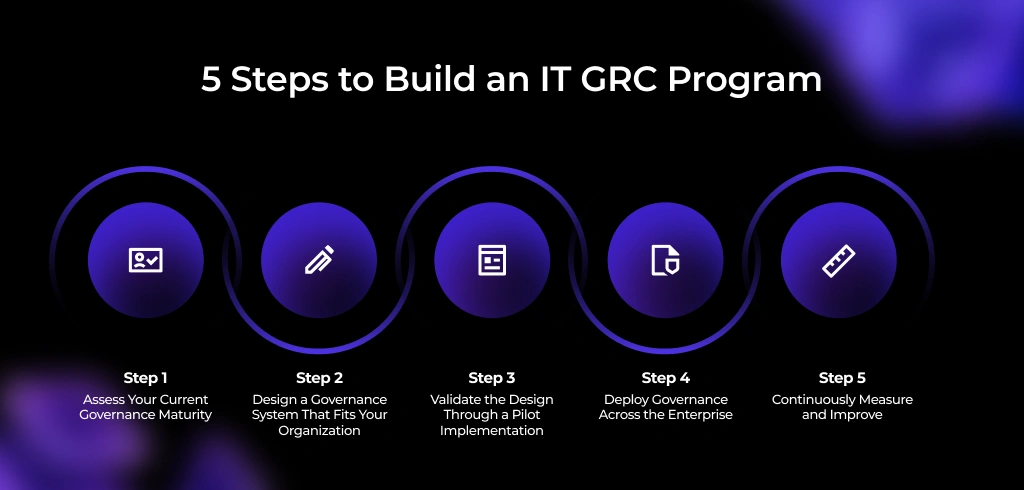
Building IT Governance, Risk, and Compliance: A 5-Stage Implementation Path
Implementing IT governance, risk, and compliance is an ongoing process rather than a one-time project. COBIT 2019 provides a flexible governance framework, but its success depends on tailoring the governance system to the organization’s size, business objectives, risk profile, and regulatory obligations. Following a structured implementation approach helps organizations reduce deployment risks and build a governance program that can evolve over time.