


Let’s be honest. If you are a network engineer and you have not used ChatGPT or Copilot to generate a config or troubleshoot a routing issue at least once, you are probably in the minority. AI for network engineers has made its way into the daily workflow of NetOps teams across the industry, and for good reason. They are fast, they are reasonably accurate on syntax, and they save time on repetitive tasks.
But here is what the glossy AI capability articles are not telling you: the biggest risk in modern network engineering is not AI getting something wrong. It is engineers not checking whether AI got something wrong before hitting Enter on a live device.
AI for network engineersis most useful as an accelerator, not an authority. It can generate syntax, suggest troubleshooting paths, and surface relevant documentation in seconds. What it cannot do is see your live network, read your active customer SLAs, or know the specific line-card limitations of the hardware in your rack right now.
That distinction, between what AI can do and what it actually knows, is where configurations go wrong and outages happen.
 Most of the industry literature on AI in network engineering focuses on capability: what these tools can do, how fast they are, what they will be able to do next. The field-level conversation about human behavioural risks when engineers rely on AI under pressure is almost entirely missing.
Here is what that actually looks like in practice.
AI tools operate completely blind to your live network. An LLM generating a Cisco IOS-XR configuration has no access to your current routing tables, no knowledge of the BGP community strings your team has built over years, and no awareness of the specific hardware release running on that line card. It is generating the most statistically likely correct answer based on training data. In many cases that answer is fine. In some cases, it is not, and the delta between “fine” and “not fine” on a live carrier network is an outage.
Deprecated commands are a real and underappreciated risk. IOS-XR evolves across releases. A command that was valid syntax in one version may be deprecated, modified, or behave differently in the version running on your production device. An LLM trained on aggregated documentation does not always get this right, and it does not always flag the uncertainty either. It will often generate deprecated syntax with the same confidence it generates current syntax.
Pressure accelerates the problem. During a live fault or a tight maintenance window, the instinct is to move fast. AI tools feed that instinct. They produce output immediately, the output looks correct, and the cognitive load of a time-pressured engineer makes thorough validation feel like friction. This is precisely when validation matters most, and when it is most likely to be skipped.
The accountability gap is real. When a configuration causes an outage, the LLM that generated it is not in the post-mortem. The engineer who applied it is. This is not a technicality. It reflects a genuine responsibility that cannot be delegated to a generative AI tool, regardless of how confident the output looks.
Most of the industry literature on AI in network engineering focuses on capability: what these tools can do, how fast they are, what they will be able to do next. The field-level conversation about human behavioural risks when engineers rely on AI under pressure is almost entirely missing.
Here is what that actually looks like in practice.
AI tools operate completely blind to your live network. An LLM generating a Cisco IOS-XR configuration has no access to your current routing tables, no knowledge of the BGP community strings your team has built over years, and no awareness of the specific hardware release running on that line card. It is generating the most statistically likely correct answer based on training data. In many cases that answer is fine. In some cases, it is not, and the delta between “fine” and “not fine” on a live carrier network is an outage.
Deprecated commands are a real and underappreciated risk. IOS-XR evolves across releases. A command that was valid syntax in one version may be deprecated, modified, or behave differently in the version running on your production device. An LLM trained on aggregated documentation does not always get this right, and it does not always flag the uncertainty either. It will often generate deprecated syntax with the same confidence it generates current syntax.
Pressure accelerates the problem. During a live fault or a tight maintenance window, the instinct is to move fast. AI tools feed that instinct. They produce output immediately, the output looks correct, and the cognitive load of a time-pressured engineer makes thorough validation feel like friction. This is precisely when validation matters most, and when it is most likely to be skipped.
The accountability gap is real. When a configuration causes an outage, the LLM that generated it is not in the post-mortem. The engineer who applied it is. This is not a technicality. It reflects a genuine responsibility that cannot be delegated to a generative AI tool, regardless of how confident the output looks.
How AI Has Changed Network Engineering Workflows
The shift has been fast. A few years ago, a network engineer troubleshooting a BGP session issue would go to vendor documentation, search through protocol RFCs, or open a TAC case. Today, the same engineer is likely to paste the error output into ChatGPT and start from the generated response. This is not inherently bad. AI in network engineering has made certain workflows genuinely faster. Syntax generation for IOS-XR configurations that would have taken twenty minutes to look up now takes two. Troubleshooting paths for common OSPF adjacency failures or MPLS label-switching issues are surfaced in seconds. For engineers working in time-pressured maintenance windows, that speed has real operational value. The problem is what happens next. Across experience levels, from junior engineers to experienced architects, there is a growing pattern of treating LLM outputs as a first-and-final answer rather than a starting point. Configurations get copied directly from the AI response into a terminal session on a production device, sometimes without a second read, let alone a lab test. On a carrier-grade network running IOS-XR with active BGP sessions carrying customer traffic and MPLS paths supporting production SLAs, a single flawed configuration line can have a blast radius that no one in the room is prepared for.The Risks of AI in Network Operations That Nobody Talks About
Most of the industry literature on AI in network engineering focuses on capability: what these tools can do, how fast they are, what they will be able to do next. The field-level conversation about human behavioural risks when engineers rely on AI under pressure is almost entirely missing.
Here is what that actually looks like in practice.
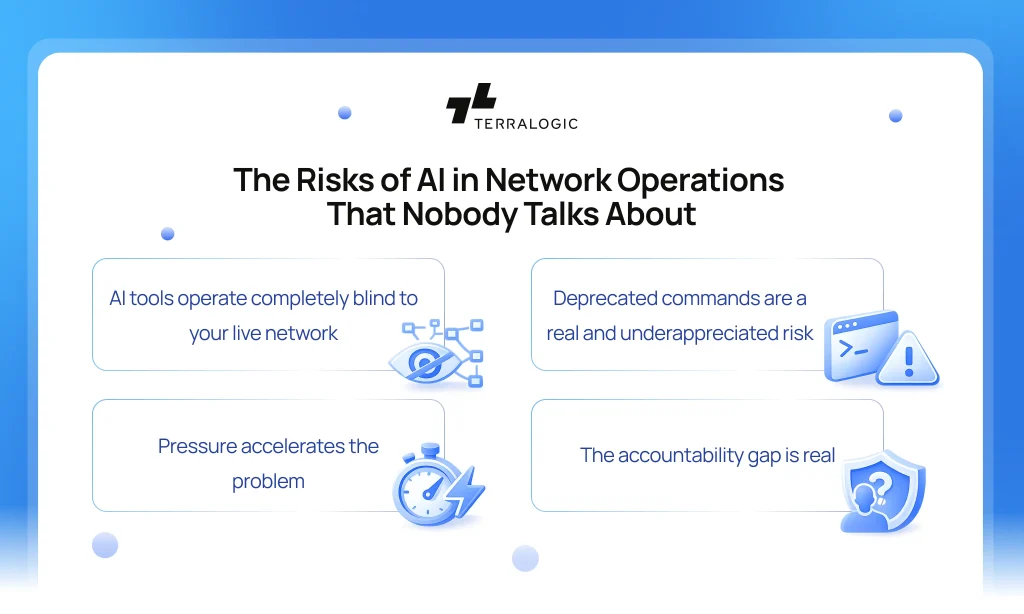
AI tools operate completely blind to your live network. An LLM generating a Cisco IOS-XR configuration has no access to your current routing tables, no knowledge of the BGP community strings your team has built over years, and no awareness of the specific hardware release running on that line card. It is generating the most statistically likely correct answer based on training data. In many cases that answer is fine. In some cases, it is not, and the delta between “fine” and “not fine” on a live carrier network is an outage.
Deprecated commands are a real and underappreciated risk. IOS-XR evolves across releases. A command that was valid syntax in one version may be deprecated, modified, or behave differently in the version running on your production device. An LLM trained on aggregated documentation does not always get this right, and it does not always flag the uncertainty either. It will often generate deprecated syntax with the same confidence it generates current syntax.
Pressure accelerates the problem. During a live fault or a tight maintenance window, the instinct is to move fast. AI tools feed that instinct. They produce output immediately, the output looks correct, and the cognitive load of a time-pressured engineer makes thorough validation feel like friction. This is precisely when validation matters most, and when it is most likely to be skipped.
The accountability gap is real. When a configuration causes an outage, the LLM that generated it is not in the post-mortem. The engineer who applied it is. This is not a technicality. It reflects a genuine responsibility that cannot be delegated to a generative AI tool, regardless of how confident the output looks.