



Many organizations invest heavily in cybersecurity technologies, frameworks, and compliance programs. Yet despite these investments, security incidents, audit findings, and governance failures continue to occur. In many cases, the problem is not a lack of security controls. It is a lack of effective governance.
Information security governance provides the structure that ensures security supports business objectives, aligns with risk appetite, and receives appropriate oversight from leadership. It helps answer critical questions that technology alone cannot solve:
 Information security governance and information security management are closely related, but they are not the same thing. In fact, one of the most common mistakes organizations make is treating them as interchangeable.
At a high level, governance is responsible for setting direction and oversight, while management is responsible for execution and operations. Governance determines what the organization wants to achieve from a security perspective, and management is responsible for achieving those objectives.
A simple way to distinguish between the two is to look at the nature of the activity:
Information security governance and information security management are closely related, but they are not the same thing. In fact, one of the most common mistakes organizations make is treating them as interchangeable.
At a high level, governance is responsible for setting direction and oversight, while management is responsible for execution and operations. Governance determines what the organization wants to achieve from a security perspective, and management is responsible for achieving those objectives.
A simple way to distinguish between the two is to look at the nature of the activity:
- Are we investing in the right security priorities?
- Does leadership have visibility into cybersecurity risks?
- Who is accountable when security objectives are not met?
- How do we know our security program is delivering business value?
Key Takeaways
- Information security governance is the system by which an organization’s governing body directs and oversees information security activities.
- Governance and management are not the same. Governance sets direction and accountability, while management implements and operates security controls.
- ISO/IEC 27014 is the leading international standard for information security governance.
- Effective governance is built on six principles and five governance processes defined by ISO 27014.
- Strong governance requires participation from the board, executive leadership, CISO, security teams, and assurance functions.
- Organizations with mature governance programs are better positioned to align cybersecurity investments with business objectives, regulatory requirements, and risk management goals.
- Information security governance is not a one-time project. It is a continuous cycle of evaluation, direction, monitoring, communication, and assurance.
What Is Information Security Governance?
Information security governance is the system by which an organization’s leadership directs and oversees information security. According to ISO/IEC 27014, it is the means by which a governing body provides overall direction and control of activities that affect the security of the organization’s information. Its purpose is to ensure that information security supports business objectives, aligns with the organization’s risk appetite, and receives appropriate oversight from leadership. Unlike information security management, which focuses on implementing and operating security controls, information security governance focuses on setting direction, allocating resources, monitoring performance, and holding people accountable for security outcomes. In simple terms, governance determines what security outcomes the organization wants to achieve, while management is responsible for achieving them.The 6 Principles of Information Security Governance
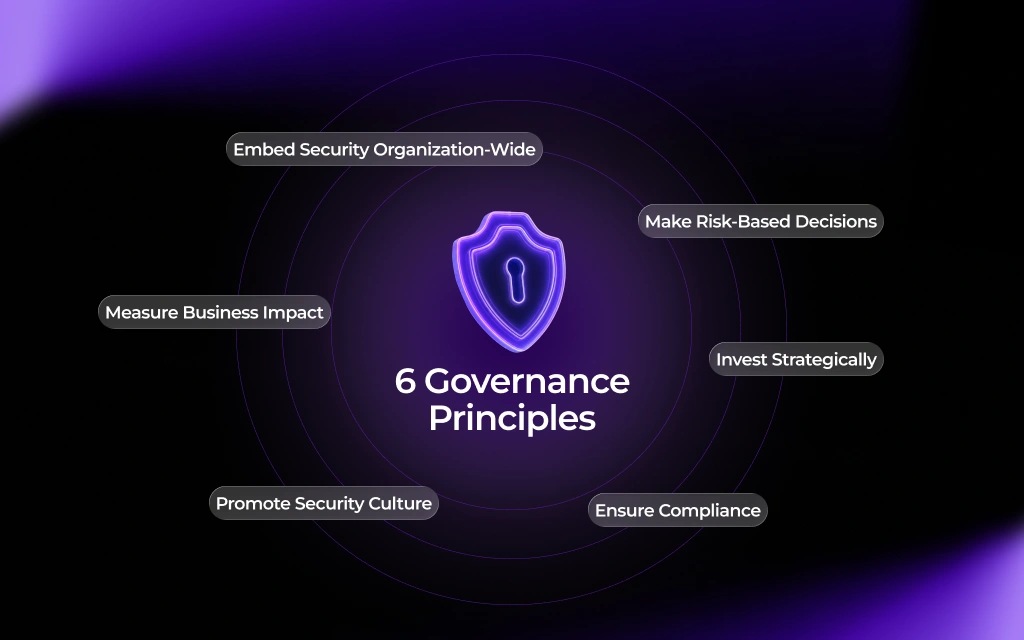
Effective information security governance is not built on policies alone. It requires a set of principles that help leadership make consistent decisions about security, risk, investment, and accountability. ISO/IEC 27014 defines 6 governance principles that provide this foundation. Together, they help governing bodies ensure that information security supports business objectives, protects critical assets, and delivers measurable value to the organization. Importantly, these principles are designed to work as a system. For example, an organization may adopt a risk-based approach but fail to review whether its security investments are delivering meaningful outcomes. Similarly, strong compliance efforts can still fall short if employees do not understand their role in maintaining security. Effective governance requires all 6 principles working together.
1. Embed Security Organization-Wide
One of the most common governance failures is treating information security as an IT responsibility rather than an organizational responsibility. When security is confined to the IT department, business leaders often view it as a technical issue instead of a business risk. ISO 27014 emphasizes that information security should be embedded throughout the organization. The governing body should ensure that security objectives support business objectives and that every function understands its role in protecting information. This principle shifts security from being a technical program to being a business-wide responsibility. Example: Rather than maintaining a standalone cybersecurity strategy, an organization integrates security objectives into business initiatives such as digital transformation, cloud adoption, product development, and third-party risk management.2. Make Risk-Based Decisions
Organizations often make security decisions based on industry trends, recent incidents, or compliance requirements. While these factors are important, they do not necessarily reflect the organization’s actual risk exposure. ISO 27014 therefore requires a risk-based approach. Security priorities, investments, and controls should be driven by business risk and aligned with the organization’s risk appetite. The goal is to focus resources where they will have the greatest impact rather than trying to protect everything equally. Example: A financial institution allocates more resources to protecting customer data and payment systems because the business impact of compromise is significantly higher than that of less critical internal applications.3. Invest Strategically
Information security governance is not responsible for selecting technologies or configuring controls. However, it is responsible for ensuring that security investments support organizational priorities and deliver value. This principle requires leadership to oversee how security resources are allocated and whether those investments contribute to business objectives and risk reduction. Instead of asking, “How much are we spending on security?”, governance should ask, “Are we investing in the areas that matter most to the business?” Example: The board approves additional investment in identity security after determining that unauthorized access represents one of the organization’s highest cyber risks.4. Ensure Compliance
Organizations operate under a growing number of legal, regulatory, contractual, and internal requirements. Governance must ensure that information security activities align with these obligations and that compliance can be demonstrated when required. This principle goes beyond passing audits. It focuses on providing confidence that security practices consistently meet applicable requirements and that evidence exists to support that claim. Without governance oversight, compliance efforts often become fragmented and reactive. Example: An organization maps its security controls to ISO 27001, GDPR, industry regulations, and internal policies, ensuring that compliance obligations are tracked and continuously monitored.5. Promote Security Culture
Even the most advanced security technologies can be undermined by poor security culture. Employees make decisions every day that affect information security, whether they realize it or not. ISO 27014 therefore emphasizes the importance of creating an environment where security is understood as a shared responsibility rather than the sole responsibility of the security team. Leadership plays a critical role in setting expectations, demonstrating commitment, and reinforcing accountability throughout the organization. Example: Executives actively participate in security awareness initiatives and incident response exercises, demonstrating that security is a leadership priority rather than just an IT concern.6. Measure Business Impact
A common governance mistake is measuring security performance using technical metrics that provide little insight into business impact. While metrics such as vulnerabilities patched or alerts investigated are useful operational indicators, they do not tell leadership whether security objectives are being achieved. ISO 27014 encourages governing bodies to evaluate security performance in terms of business outcomes. The focus should be on understanding how security contributes to resilience, risk reduction, regulatory compliance, and organizational objectives. This helps leadership make better decisions about future investments, priorities, and risk management strategies. Example: Instead of only reviewing vulnerability counts, the board reviews trends in security incidents, reductions in business disruption, audit findings, and overall risk exposure.The 5 Governance Processes: How Information Security Governance Works
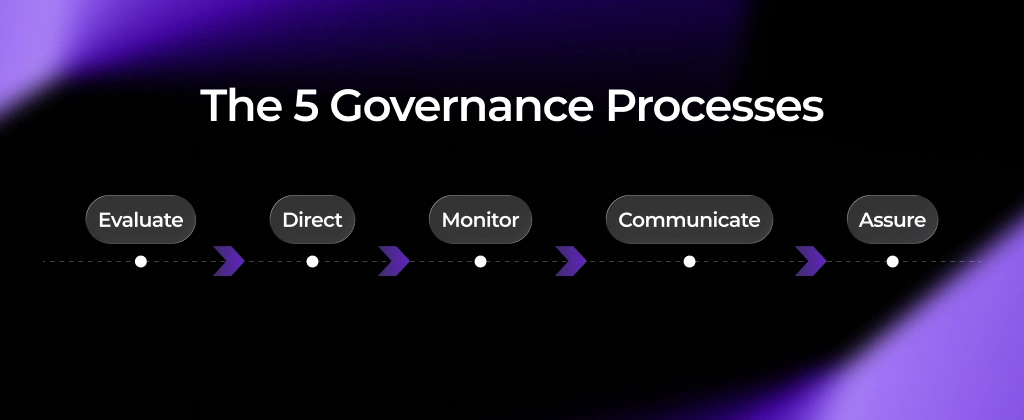
The 6 principles of ISO/IEC 27014 define what effective information security governance should achieve. The 5 governance processes define how governing bodies put those principles into practice. Together, these processes create a continuous governance cycle. Leadership evaluates the organization’s security position, provides direction, monitors progress, communicates expectations and outcomes, and obtains assurance that governance is working as intended. The findings from assurance activities then feed back into the next evaluation cycle, allowing the organization to continuously improve its security posture and governance effectiveness.
1. Evaluate
Every governance decision starts with understanding the organization’s current security position. Before leadership can approve investments, set priorities, or establish objectives, it must first determine whether the organization’s existing security capabilities are sufficient to support business goals and manage risk effectively. The Evaluate process focuses on assessing both internal and external factors that may affect information security. This includes reviewing business objectives, risk exposure, security performance, regulatory developments, emerging threats, and changes in the operating environment. The goal is to understand whether the organization is adequately protected today and whether it is prepared for future challenges. For example, leadership may review recent security incidents, audit findings, third-party risks, and planned business initiatives to determine whether current security strategies remain appropriate. The outcome of this process is a clear picture of where the organization stands and what issues require attention.2. Direct
Once leadership understands the organization’s security position, it must decide what actions should be taken. This is the purpose of the Direct process. The governing body provides direction by setting security objectives, approving strategy, defining risk tolerance, allocating resources, and establishing accountability. These decisions provide management with clear guidance on what outcomes the organization expects to achieve and what level of risk is considered acceptable. This process highlights the distinction between governance and management. Governance does not decide how controls should be implemented or which technologies should be deployed. Instead, it establishes priorities and expectations that management must execute. For example, the board may identify ransomware resilience as a strategic priority and approve additional investment, while management determines the specific technologies, processes, and controls required to achieve that objective.3. Monitor
After providing direction, leadership must verify that the organization is making progress toward its objectives. Governance without oversight quickly becomes ineffective because decisions are made without understanding whether they are producing the desired results. The Monitor process provides visibility into security performance and risk exposure. It allows the governing body to determine whether management is executing approved strategies, whether investments are delivering value, and whether security objectives are being achieved. Monitoring also helps identify deviations from expectations so corrective action can be taken before issues become significant problems. Effective monitoring focuses on business outcomes rather than purely technical metrics. While operational teams may track vulnerabilities, alerts, and system events, leadership is typically more concerned with measures such as risk reduction, regulatory compliance, operational resilience, and the impact of security incidents on business operations.4. Communicate
Information security governance depends on effective communication across the organization. Security decisions, expectations, risks, and performance information must be shared with the appropriate stakeholders so they can make informed decisions and fulfill their responsibilities. The Communicate process ensures that governance-related information flows between leadership, management, employees, regulators, customers, and other interested parties. Different stakeholders require different types of information. Executive leadership may need strategic risk updates, regulators may require evidence of compliance, and employees need clear guidance on their security responsibilities. Strong communication also helps build trust and accountability. When stakeholders understand the organization’s security objectives, risk posture, and governance decisions, it becomes easier to align day-to-day activities with broader business goals.5. Assure
The final process is assurance. While monitoring provides visibility into performance, assurance provides independent confidence that governance activities are functioning as intended and that leadership is receiving accurate information on which to base decisions. Assurance activities validate whether security controls, governance processes, and reporting mechanisms are effective. They help identify weaknesses, confirm compliance with requirements, and provide an objective assessment of whether governance objectives are being achieved. Assurance can come from internal audits, external audits, certification assessments, regulatory reviews, or other independent evaluations. Importantly, assurance is not the end of the governance process. Findings from audits and assessments often reveal new risks, gaps, or improvement opportunities. These insights feed directly back into the Evaluate process, creating a cycle of continuous improvement. This is why ISO 27014 treats governance as an ongoing discipline rather than a one-time initiative.ISG Structure: Who Governs Information Security?
One of the most common misconceptions about information security governance is that it belongs solely to the security team or IT department. In reality, governance is a shared responsibility that spans multiple levels of the organization, from the boardroom to frontline employees. While security teams manage day-to-day operations, governance focuses on accountability, oversight, and decision-making. Each role within the governance structure has a different responsibility, but all contribute to ensuring that information security supports business objectives and manages risk effectively.1. Governing Body (Board of Directors)
The governing body holds ultimate accountability for information security governance. Its role is not to manage security controls or investigate incidents, but to provide oversight, approve strategic direction, and ensure that cyber risks are being managed appropriately. The board is responsible for approving security strategy, defining risk appetite, reviewing major security investments, and receiving regular reporting on security performance and risk exposure. Increasingly, regulators and stakeholders expect boards to demonstrate active oversight rather than simply approving policies once a year.2. Executive Management and the CISO
Executive leadership acts as the bridge between governance and execution. Once the board establishes direction, executive management is responsible for translating that direction into business and security strategies that can be implemented across the organization. The Chief Information Security Officer (CISO) plays a particularly important role. Beyond managing the security function, the CISO helps leadership understand cyber risks, advises on security investments, and reports on the effectiveness of the security program. A notable trend in recent years is the growing expectation that CISOs have direct access to the board. Rather than reporting through multiple management layers, many organizations now recognize that security risks should be communicated directly to decision-makers, reflecting the strategic importance of cybersecurity.3. Security Leadership and the ISMS Owner
If governance defines what the organization wants to achieve, security leadership is responsible for making it happen. The ISMS owner, CISO, and security teams operate the Information Security Management System (ISMS), implement controls, manage security operations, and respond to incidents. They also maintain the policies, procedures, and records that demonstrate compliance and support governance oversight. Perhaps most importantly, this group generates the evidence that governance relies on. Risk assessments, audit results, control performance metrics, incident reports, and compliance records all originate from operational security activities and are used by leadership to make informed decisions.4. Internal Audit and Assurance Functions
Effective governance requires independent verification. Leadership needs confidence that security controls are operating as intended and that reporting accurately reflects the organization’s security posture. This is the role of internal audit and other assurance functions. They provide objective assessments of governance processes, security controls, compliance activities, and risk management practices. Their findings help identify weaknesses, validate performance claims, and ensure accountability across the organization. As organizations mature, assurance activities are increasingly supported by continuous monitoring and automated controls testing, allowing governance bodies to receive more timely visibility into security performance.5. Employees and Business Functions
Information security governance is often associated with boards, executives, and security teams, but employees also play an important role. Every employee interacts with information, systems, and business processes that can affect security outcomes. Their daily decisions influence whether policies are followed, risks are reported, and controls operate effectively. A governance framework can establish direction and accountability, but its success ultimately depends on how those expectations are carried out throughout the organization. This is why ISO 27014 emphasizes fostering a security-positive environment. Effective governance encourages employees to view security as part of their responsibilities rather than someone else’s job.Information Security Governance vs Information Security Management
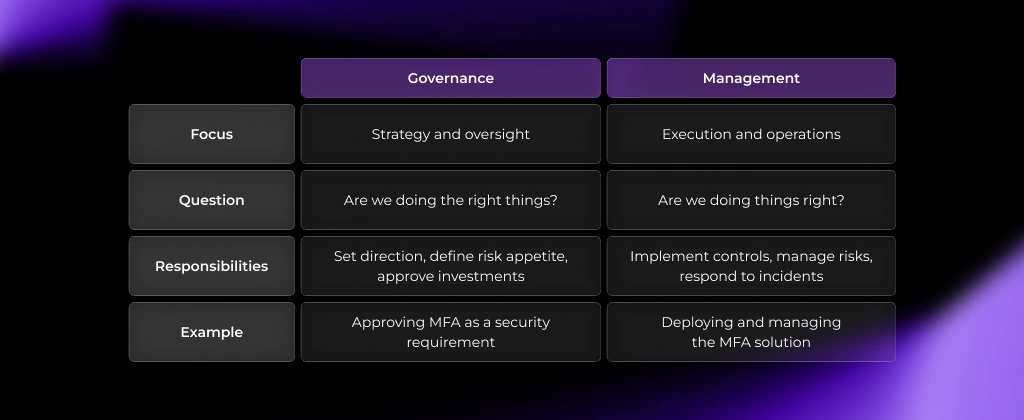
Information security governance and information security management are closely related, but they are not the same thing. In fact, one of the most common mistakes organizations make is treating them as interchangeable.
At a high level, governance is responsible for setting direction and oversight, while management is responsible for execution and operations. Governance determines what the organization wants to achieve from a security perspective, and management is responsible for achieving those objectives.
A simple way to distinguish between the two is to look at the nature of the activity:
- If the activity involves setting strategy, approving budgets, defining risk appetite, or holding people accountable for outcomes, it is governance.
- If the activity involves implementing controls, managing vulnerabilities, conducting risk assessments, responding to incidents, or maintaining security systems, it is management.