


Cybersecurity has evolved far beyond the responsibilities of IT departments and is now recognized as a critical business issue that affects every part of an organization. In 2026, cyber risks have become business risks that can affect revenue, operations, regulatory compliance, customer trust, and long-term growth. From ransomware attacks and supply chain compromises to AI-powered threats and data breaches, organizations face a growing number of cyber risks that evolve faster than traditional security programs can manage.
This is why cybersecurity risk management has become a critical business capability. Rather than focusing solely on implementing security controls, cybersecurity risk management helps organizations understand which threats matter most, measure their potential impact, prioritize investments, and make informed decisions about risk.
In this guide, we’ll explain what cybersecurity risk management is, explore the modern threat landscape, compare leading frameworks and risk quantification methods, walk through the steps of building a cybersecurity risk management program, and share best practices for managing cyber risks in 2026.

Key Takeaways
- Cybersecurity risk management is the process of identifying, assessing, prioritizing, and reducing cyber risks that could affect business operations, data, systems, and organizational objectives.
- Modern cybersecurity risk management extends beyond technical controls and increasingly supports board reporting, business decision-making, and regulatory compliance.
- Frameworks such as NIST CSF 2.0, ISO 27001, CIS Controls, and FAIR provide structured approaches for managing and measuring cyber risk.
- The most significant cyber risks in 2026 include ransomware, third-party risk, identity-based attacks, AI-enabled threats, and IT/OT convergence risks.
- Organizations with mature cybersecurity risk management programs are better positioned to improve resilience, reduce financial exposure, and respond to evolving threats.
What Is Cybersecurity Risk Management?
Cybersecurity risk management is the process of identifying, prioritizing, managing, and monitoring risks that could affect an organization’s information systems, digital assets, and data. Its purpose is to help organizations understand which cyber risks matter most and take appropriate steps to reduce their impact. As organizations become more dependent on technology, cybersecurity risks have become a major business concern. Cyberattacks, human error, system failures, third-party incidents, and other threats can disrupt operations, expose sensitive data, damage customer trust, and result in significant financial losses. While cyber risks can never be eliminated, a cybersecurity risk management program helps organizations reduce both the likelihood and potential impact of these threats. By understanding their most critical risks, organizations can make better decisions about where to invest resources, implement security controls, and strengthen resilience against future incidents.The 2026 Cyber Threat Landscape
Cybersecurity risk management begins with understanding the threats that could affect your organization. In 2026, the challenge is no longer just the volume of cyberattacks. Threats are evolving faster, spreading further, and becoming more difficult to detect as attackers leverage AI, target identities, and exploit increasingly interconnected digital ecosystems. Understanding these trends is essential for prioritizing cybersecurity investments and building an effective risk management program.
1. AI Is Increasing the Speed and Scale of Attacks
Artificial intelligence is changing how cyberattacks are conducted. Tasks that once required significant expertise and manual effort can now be automated, allowing threat actors to operate more efficiently and at a larger scale. Attackers are using AI to generate phishing content, conduct reconnaissance, analyze potential targets, and improve social engineering campaigns. As a result, organizations are facing a higher volume of more sophisticated attacks while defenders have less time to react. For cybersecurity risk management teams, this means risk assessments can no longer rely solely on historical threats. They must also account for how AI is changing attacker capabilities and increasing the speed at which risks emerge.2. Identity Has Become the New Perimeter
Traditional security strategies focused heavily on protecting networks and devices. Today, attackers increasingly target identities because legitimate user accounts provide a direct path into business systems. Credential theft, account takeovers, phishing attacks, and privilege abuse continue to be among the most effective attack methods. Once an attacker gains access to a trusted identity, they can often move through systems without triggering traditional security controls. This shift is driving greater investment in identity security, multi-factor authentication, privileged access management, and zero-trust architectures.3. The Time Available to Respond Is Shrinking
One of the most significant trends is the growing speed of cyber events. Threats can develop, spread, and cause business impact much faster than many organizations are prepared to handle. The gap between threat emergence and exploitation continues to narrow, making traditional review cycles and periodic assessments increasingly ineffective. Organizations need continuous monitoring, real-time threat intelligence, and faster decision-making processes to keep pace with modern threats. In practice, this means cybersecurity risk management is becoming a continuous activity rather than an annual or quarterly exercise.4. Third-Party Risk Is Expanding Across Digital Ecosystems
Organizations today depend on an extensive network of software vendors, cloud providers, managed service providers, and business partners. While these relationships improve efficiency and innovation, they also increase exposure to cyber risk. A security incident affecting a single supplier can quickly impact hundreds or even thousands of organizations downstream. As digital ecosystems become more interconnected, cybersecurity risk management programs must evaluate not only internal risks but also risks introduced by external partners. This is one reason vendor risk management and supply chain security have become strategic priorities for many organizations.5. Threat Volume Is Creating an Intelligence Challenge
Security teams are not suffering from a lack of threat information. Instead, they are struggling to determine which threats actually matter. The growing volume of threat activity, indicators, alerts, and intelligence signals that organizations must process. The challenge is separating meaningful risks from background noise and focusing resources on threats that could create real business impact. This is driving increased adoption of threat intelligence platforms, AI-assisted monitoring, and risk-based prioritization models that help organizations focus on the risks that matter most.Cybersecurity Risk Quantification: From Red/Amber/Green to Dollars
As organizations face increasingly complex cyber threats, traditional risk assessment methods are no longer sufficient for communicating risk to business leaders. Cybersecurity risk quantification helps translate technical risks into financial terms, enabling more informed decision-making and stronger alignment between security and business objectives.The Communication Gap in Traditional Cybersecurity Risk Management
For years, cybersecurity teams have relied on heat maps and Red/Amber/Green (RAG) matrices to communicate risk. While these tools help visualize threats, they often fail to answer the questions executives and board members care about most:- How much could this cyber risk cost the business?
- Which risks should we prioritize first?
- How much risk reduction will a security investment deliver?
NIST 800-30 vs. FAIR: Choosing the Right Approach
Organizations typically begin their cyber risk quantification journey with one of two widely adopted frameworks.1. NIST SP 800-30
NIST SP 800-30 provides a structured methodology for conducting cyber risk assessments. Organizations identify threat sources, vulnerabilities, likelihood, and business impact before assigning risk ratings. How it works:- Identify assets, threats, and vulnerabilities
- Assess the likelihood of a threat event
- Evaluate potential business impact
- Prioritize risks based on severity
- Select appropriate risk treatment options
- Define Scope and Assets: Identify the systems, applications, data, and business processes to be assessed.
- Identify Threat Sources and Vulnerabilities: Evaluate potential threat actors, attack vectors, and security weaknesses.
- Assess Likelihood and Impact: Estimate the probability of a threat occurring and the potential business consequences.
- Prioritize Risks: Rank risks based on their severity and alignment with business objectives.
- Select Risk Responses: Determine whether to mitigate, transfer, avoid, or accept each risk.
2. FAIR (Factor Analysis of Information Risk)
FAIR is a quantitative cyber risk management framework that translates cybersecurity risks into financial terms. Rather than classifying a risk as High or Medium, FAIR estimates the probable financial loss associated with a specific cyber event. How it works:- Define a specific risk scenario
- Estimate the frequency of loss events
- Estimate the probable financial impact
- Calculate Annualized Loss Expectancy (ALE)
- Compare risk reduction against investment costs
- Identify Priority Risk Scenarios: Focus on three to five critical cyber risks, such as ransomware, third-party breaches, credential compromise, or business email compromise.
- Gather Relevant Data: Collect information from internal incidents, threat intelligence sources, cyber insurance reports, and industry benchmarks to estimate potential losses.
- Quantify Financial Exposure: Use FAIR analysis and statistical modeling techniques to estimate the Annualized Loss Expectancy (ALE) for each scenario.
- Present Risk in Business Terms: Translate cyber risks into financial language that executives can understand and act on.
The NIST CSF 2.0 Cybersecurity Risk Management Framework: 6 Core Functions
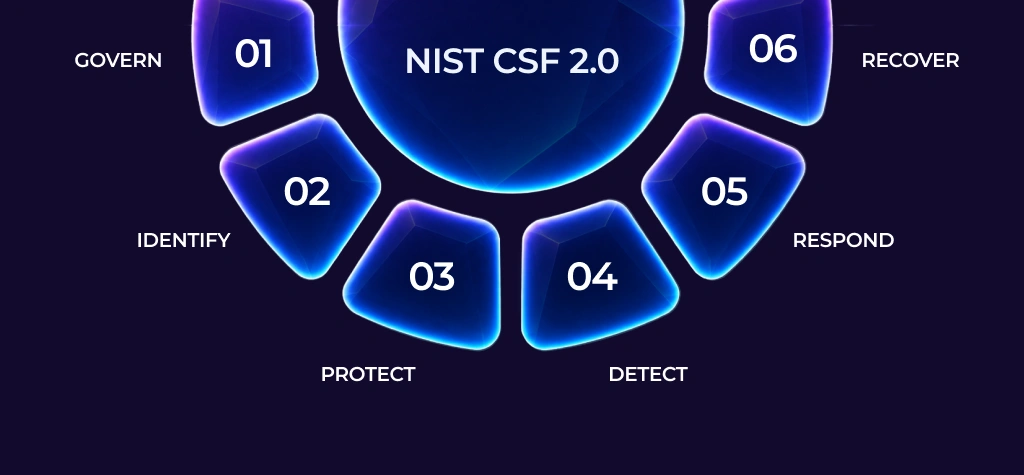
Among the many cybersecurity risk management frameworks available today, NIST Cybersecurity Framework (CSF) 2.0 is one of the most widely adopted. Originally developed by the National Institute of Standards and Technology (NIST), the framework provides a common language for managing cybersecurity risks across organizations of all sizes and industries. A major update in NIST CSF 2.0 was the introduction of the GOVERN function, which places cybersecurity governance, accountability, and risk management strategy at the center of the framework. This reflects a broader shift in cybersecurity from a technical issue managed by IT teams to a business risk that requires leadership oversight.
1. GOVERN
The GOVERN function establishes how the organization manages cybersecurity risk. It focuses on defining cybersecurity strategy, policies, responsibilities, oversight mechanisms, and risk management expectations across the organization. Key activities include:- Establishing cybersecurity governance structures
- Defining roles, responsibilities, and accountability
- Setting cybersecurity risk management policies
- Integrating cybersecurity into enterprise risk management (ERM)
- Managing cybersecurity supply chain risks
- Reporting cyber risks to leadership and the board
2. IDENTIFY
The IDENTIFY function helps organizations understand what assets they have, what risks they face, and where their most critical exposures exist. Key activities include:- Inventorying systems, applications, and data
- Identifying critical business processes
- Mapping suppliers and third-party dependencies
- Assessing vulnerabilities and threats
- Maintaining a cybersecurity risk register
3. PROTECT
The PROTECT function focuses on implementing safeguards that reduce the likelihood and impact of cybersecurity incidents. Key activities include:- Identity and access management
- Multi-factor authentication (MFA)
- Security awareness training
- Data protection and encryption
- Endpoint and infrastructure security
- Secure configuration management
4. DETECT
The DETECT function focuses on identifying potential cybersecurity incidents as quickly as possible. Key activities include:- Security monitoring and logging
- Threat detection and analytics
- Security information and event management (SIEM)
- Threat intelligence integration
- Anomaly detection
5. RESPOND
The RESPOND function covers the actions taken after a cybersecurity incident has been identified. Key activities include:- Incident investigation
- Threat containment
- Communication and reporting
- Regulatory notification
- Coordination across internal teams
6. RECOVER
The RECOVER function focuses on restoring systems, services, and business operations following a cybersecurity incident. Key activities include:- Business continuity planning
- Disaster recovery procedures
- System restoration
- Post-incident reviews
- Lessons learned and improvement planning
Building a Cybersecurity Risk Management Program: 6 Practical Steps
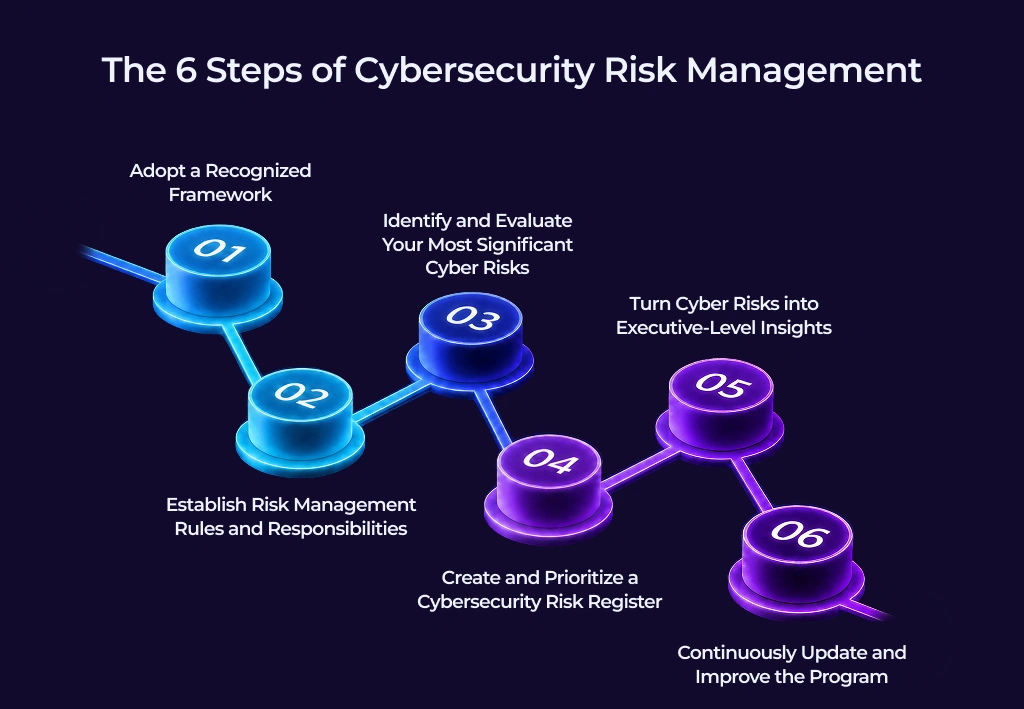
An effective cybersecurity risk management program requires more than implementing security tools and controls. Organizations need a structured process for identifying cyber risks, evaluating their impact, assigning accountability, and ensuring leadership has the visibility needed to make informed decisions. The following 6 steps provide a practical roadmap for building a cybersecurity risk management program that aligns security efforts with business objectives.
1. Adopt a Recognized Framework
Before assessing risks, organizations should establish a foundation for how cybersecurity risks will be managed. This is typically done by adopting a recognized framework such as NIST CSF 2.0, ISO 27001, or CIS Controls. A framework provides a common structure for risk assessments, governance, reporting, and continuous improvement. It also helps organizations align with regulatory requirements and industry best practices. Example: A healthcare provider adopts NIST CSF 2.0 to create a consistent approach for managing cyber risks across clinical systems, cloud environments, and third-party vendors.2. Establish Risk Management Rules and Responsibilities
Once a framework is selected, the next step is defining how cybersecurity risks will be governed across the organization. This typically takes the form of a cybersecurity risk management policy. The policy should clearly define:- How cyber risks will be assessed and scored
- Who is responsible for managing risks
- Risk appetite and tolerance thresholds
- Risk treatment options
- Reporting and escalation procedures
- Training and awareness expectations
3. Identify and Evaluate Your Most Significant Cyber Risks
The next step is understanding which cyber risks pose the greatest threat to the organization. This typically involves reviewing previous assessments, analyzing vulnerabilities, evaluating threat intelligence, and gathering input from business stakeholders. Organizations often begin by identifying their most significant risks before expanding the program over time. Common examples include ransomware, third-party compromise, cloud misconfigurations, credential theft, insider threats, and operational technology (OT) disruptions. Example: A manufacturing company identifies ransomware affecting production systems and supplier compromise as its highest-priority cybersecurity risks.4. Create and Prioritize a Cybersecurity Risk Register
Once risks have been identified, they should be documented in a centralized cybersecurity risk register. The register serves as the organization’s single source of truth for tracking cyber risk exposure. Each entry typically includes:- Risk description
- Business impact
- Likelihood rating
- Risk owner
- Existing controls
- Treatment strategy
- Target remediation actions
5. Turn Cyber Risks into Executive-Level Insights
Cybersecurity risk management becomes significantly more effective when risk information is communicated in business terms. Regular reporting helps executives and boards understand the organization’s risk exposure, evaluate investment priorities, and support informed decision-making. Effective cybersecurity reporting often includes:- The organization’s highest-priority cyber risks
- Changes in risk exposure over time
- Status of mitigation initiatives
- Emerging threats and vulnerabilities
- Key risk indicators (KRIs)
- Cybersecurity program performance metrics
6. Continuously Update and Improve the Program
Cyber risks change constantly as new technologies, vulnerabilities, business processes, and threat actors emerge. A cybersecurity risk management program should therefore be treated as a living process rather than a one-time assessment. Organizations should regularly review risk registers, reassess risk ratings, validate controls, incorporate threat intelligence, and update mitigation plans based on changing business and threat conditions. Important inputs include:- Penetration test results
- Vulnerability assessments
- Security incidents
- Threat intelligence reports
- Vendor risk reviews
- Regulatory changes
LEAVE A COMMENT
We really appreciate your interest in our ideas. Feel free to share anything that comes to your mind.